Prague Tram 42 – Complete Tourist Tram Guide
Explore Prague’s Tram 42 with a detailed stop-by-stop guide: map, highlights, timetables, and Prague Visitor Pass perks.
Overview
Tram Line No. 42 is Prague’s historical tourist tram that strings together more than sixty monuments, parks and gardens, cultural institutions, and beloved city corners. Wherever you hop off, you’ll be within reach of major attractions.
Prague Visitor Pass: Free admission or discounts at experiences marked with the Pass. Bring it along and watch the savings add up.
Photo Credit
Turistická tramvaj s vlečným vozem — Source: Prague City Tourism — Photo: David Vančišin.
How to Ride
- Frequency: Tourist service with seasonal variations
- Tickets: Purchase on site or from official partners; check visitor pass benefits
- Accessibility: Vintage sets have limited accessibility; plan stops accordingly
- Best Times: Early mornings for calm lanes; golden hour for photos
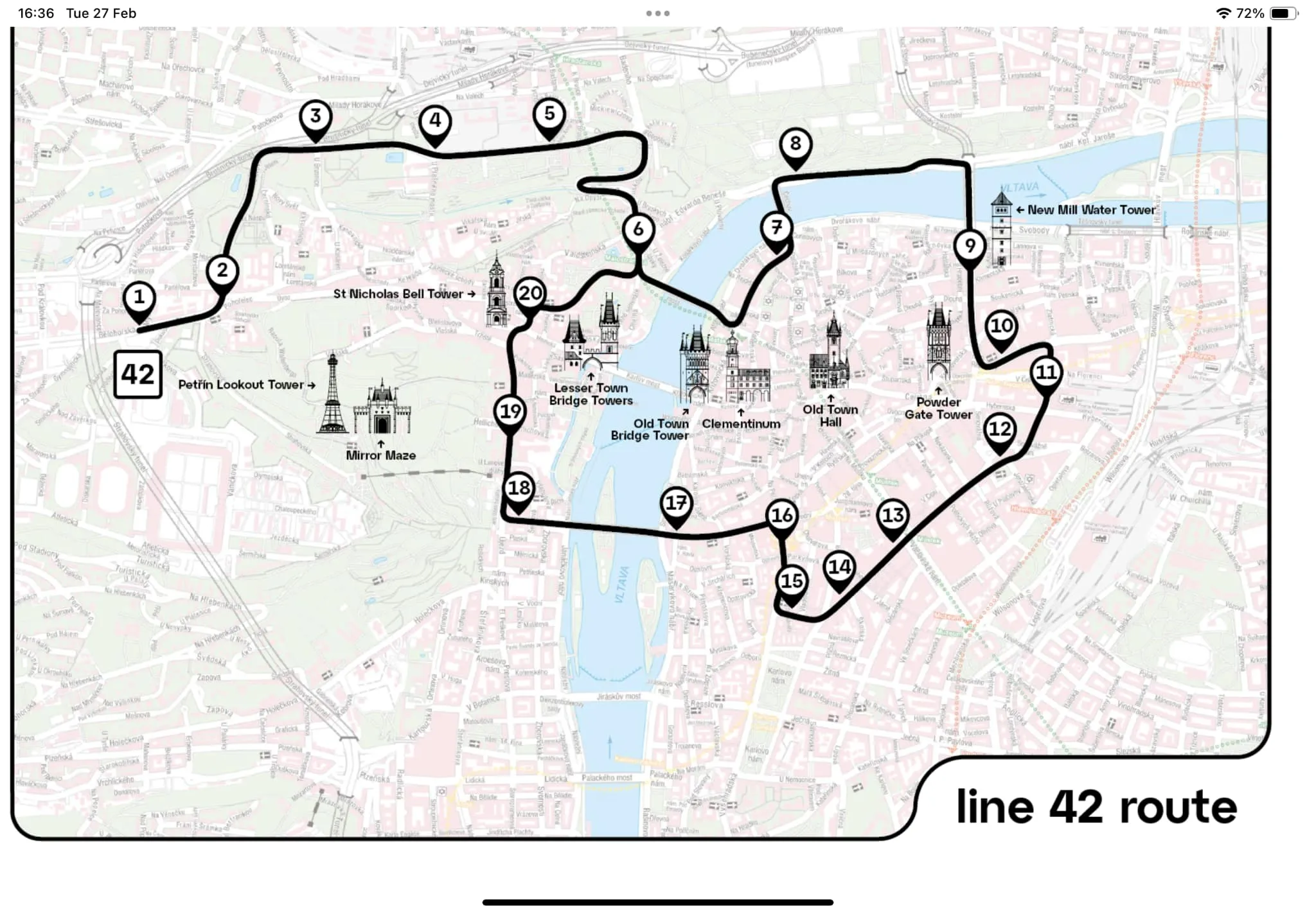
Route Map
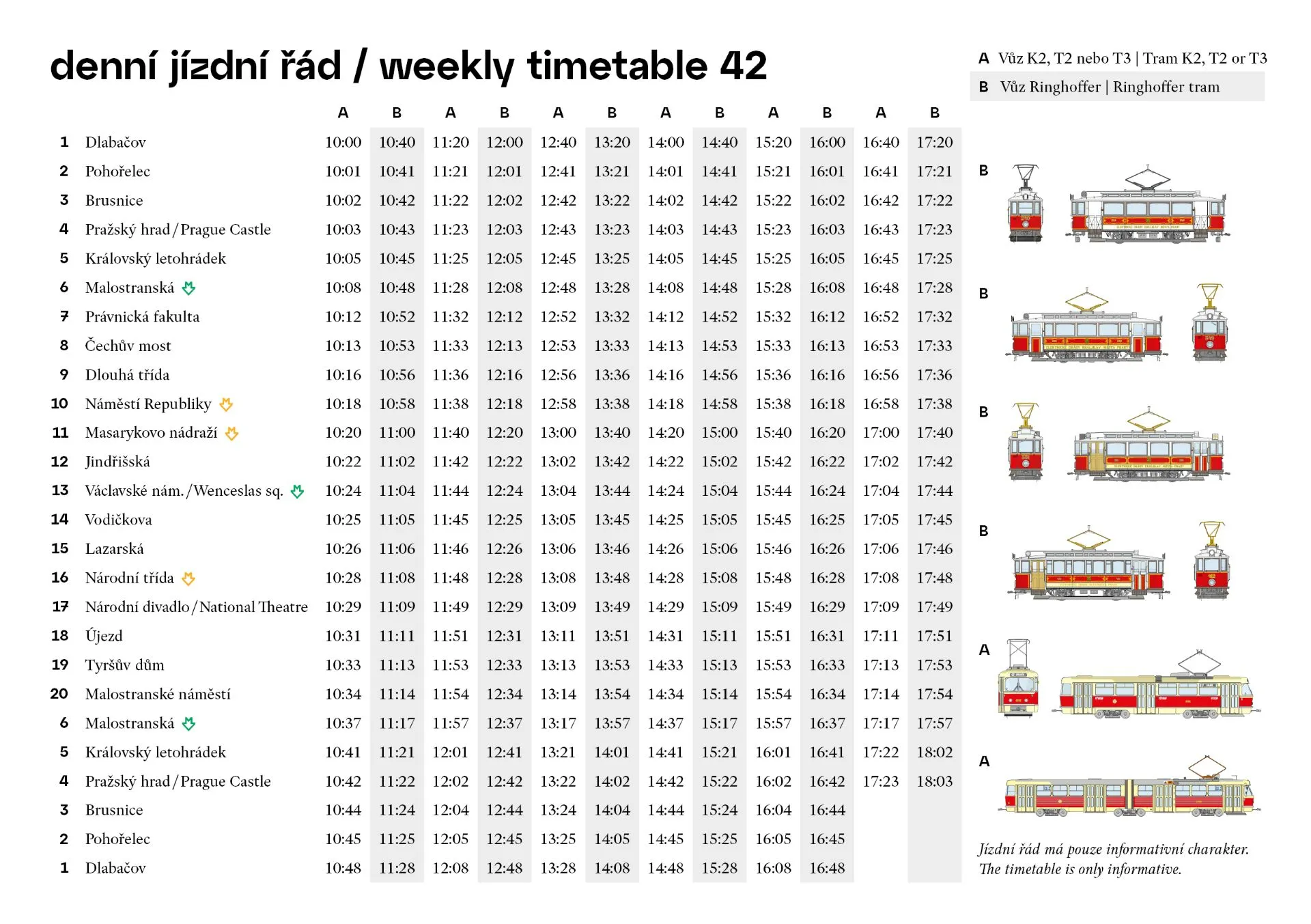
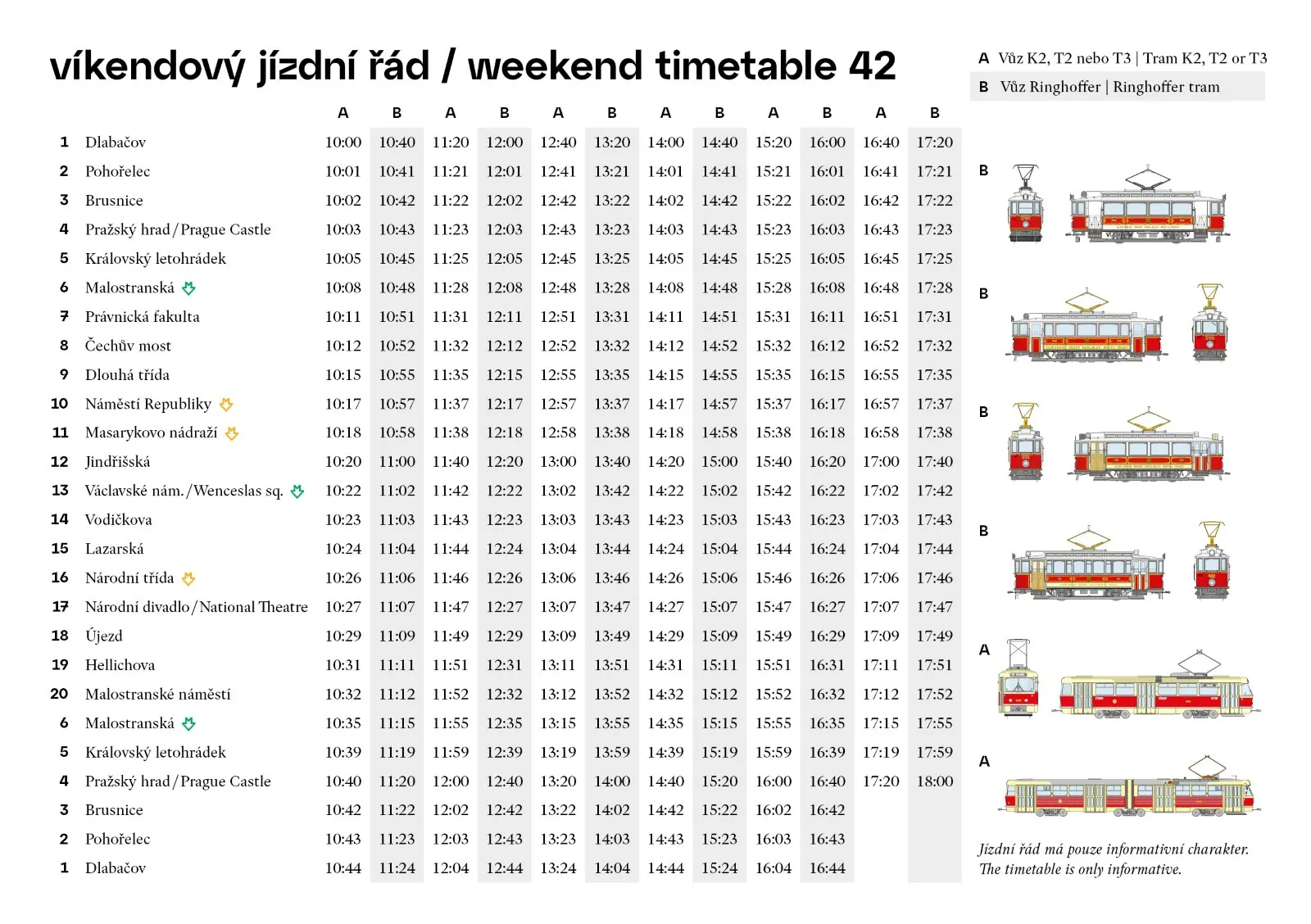
Stop-by-Stop Guide
1) Dlabačov Stop
- Dlabačov terminal loop — transport node for Strahov Stadium, the largest stadium by footprint globally
- Tram loop transformed into a community space in 2022
- Bistro inside an iconic decommissioned T3 tram
Strahov Monastery
- Oldest Premonstratensian monastery in Bohemia; houses the remains of St Norbert
- Library: 200,000+ volumes; ~1,500 incunabula
- Picture gallery: ~1,500 rare paintings (14th–19th centuries)
Monastery Churches
- W. A. Mozart improvised on the organ in 1787 (Basilica of the Assumption)
- Church of St Roch: built by Emperor Rudolf II in gratitude for the end of the plague
2) Pohořelec Stop
Astronomers’ Monument
- Sculpture of Tycho Brahe and Johannes Kepler by Josef Vajce
- Stands on the site of Kurz’s Villa, where they lived in Prague
- Behind it: Johannes Kepler grammar school (top-rated in Czechia)
Petřín Tower (Prague Visitor Pass)
- Steel tower (1891) with observation terrace ~20 m above ground
- A one-fifth-size “Eiffel”—tops of both towers align in elevation above sea level
- Nearby: Mirror Maze in a unique 130-year-old wooden building (Prague Visitor Pass)
Czernin Palace
- Among the largest Baroque buildings in Prague; seat of the Ministry of Foreign Affairs
- Site of the still unexplained death of Foreign Minister Jan Masaryk (1948)
- Garden holds a Czech–Bavarian boundary stone symbolizing the border opening (1990)
Loreto (Prague Visitor Pass)
- Baroque complex on Loretánské náměstí; Loreto Chapel at its heart
- Tower houses Europe’s largest historic church carillon—30 bells, 27 playable
Max van der Stoel Park
- Named for the first Western European politician to contact Charter 77
- Partly on the site of an abolished military cemetery; tombstones set into walls
3) Brusnice Stop
City Orphanage
- 1913 geometric Art Nouveau by Josef Rosipal
- Unique flat roof—rare at the time, possibly Prague’s first
- Today: Ministry of Culture
Upper Lumbe Garden
- Within Prague Castle; formerly owned by naturalist Josef Lumbe
- Grassy areas with trees—counterpoint to decorative gardens
- Partial access from the picturesque Nový svět (New World)
Lower Lumbe Garden
- Private garden for the presidential Lumbe Villa
- ~72 plant species grown to decorate castle protocol events
- Masaryk’s apiary designed by Josip Plečnik—still active, eight hives
4) Pražský hrad (Prague Castle) Stop
Prague Castle (Prague Visitor Pass)
- Largest inhabited castle complex worldwide; seat of the President
- St Vitus Cathedral: tomb of Czech kings; houses crown jewels (Prague Visitor Pass)
- Golden Lane (Zlatá ulička): famed alchemists’ residences (Prague Visitor Pass)
Královská zahrada (Royal Garden)
- Renaissance garden (1534); opens in summer
- Home to Prague Castle’s Míčovna (Ball Games Hall), a national cultural monument
- Separated from the castle by Jelení příkop (Deer Moat)
Mariánské hradby (Marian Walls)
- Preserved Baroque fortifications; fragments protected
- Blanka tunnel (5,502 m)—longest urban tunnel in Europe—runs beneath
5) Královský letohrádek Stop
Queen Anne’s Summer Palace
- Classic Renaissance architecture, unique outside Italy
- Commissioned by Emperor Ferdinand I for his beloved wife Anne
- Used by Tycho Brahe and Johannes Kepler for astronomical observations
Singing Fountain
- Renaissance design by Francesco Terzio
- Water falling on the bronze bowl creates concert-pitch-like tones
- Put your ear underneath to hear distant “ringing” of Prague’s bells
Bílek Villa (Prague Visitor Pass)
- Art Nouveau villa by sculptor/mystic František Bílek
- Entrance evokes an Ancient Egyptian temple; arched plan recalls a scythe’s path
- Managed by Prague City Gallery; open daily except Monday
6) Malostranská (Lesser Town) Stop
Kunsthalle Praha (Prague Visitor Pass)
- Multifunctional cultural space with gallery, lectures, and social halls
- Housed in the reconstructed Zenger transformer station (cultural monument)
- Hosts international modern art exhibitions; building a permanent collection
Waldstein Riding School
- Early Baroque (1630); Czech cultural monument
- Part of the Senate complex (like Waldstein Palace)
- National Gallery uses it for short‑term exhibitions via long‑term lease
Straka Academy
- Neo‑Baroque dormitory for poor sons of Czech nobility (originally)
- Seat of the Office of the Government of the Czech Republic since 1993
7) Právnická fakulta (Law Faculty) Stop
Law Faculty
- Neo‑Classicist (1924–31); designed by Jan Kotěra; built by Ladislav Machoň
- Imposing 3‑floor marble vestibule—frequent film location
- Houses Collegium Maximum lecture hall (cap. 560; 100 more than Charles University auditorium)
InterContinental
- Brutalist landmark by Karel Filsak
- Preserves Miroslav Hejný’s wooden sculpture set “Začarovaný les” (Enchanted Forest)
- Luxury hotel, includes a presidential suite
Jewish Quarter
- Jewish Museum: most visited Jewish monument outside Israel (Prague Visitor Pass)
- Old New Synagogue: oldest in Central Europe, still active (Prague Visitor Pass)
- Old Jewish Cemetery: tomb of Rabbi Löw, alleged creator of the Golem (Prague Visitor Pass)
8) Svatopluk Čech Bridge
Svatopluk Čech Bridge
- Shortest Prague bridge over the Vltava (169 m)
- Only steel arch bridge in Prague
- Only Art Nouveau–decorated bridge of its size in Czechia; technical monument
Prague Metronome
- Mobile artefact by Vratislav Novák (“Stroj času” / Time Machine), popularly the Metronome
- Height incl. pendulum: 25 m; 7 tonnes; swings through 60°
- Installed in 1991 on the former site of the removed Stalin monument (largest group sculpture in Europe)
Letná Park
- Large park above the Vltava with unique castle views
- Hanavský pavilon: technical monument from the 1891 General Land Centennial Exhibition
- Letenský kolotoč: Europe’s oldest preserved carousel (technical cultural monument)
9) Dlouhá třída Stop
New Mill Water Tower (Prague Visitor Pass)
- Built 1658; supplied lower New Town with Vltava water until 1877
- Observation hall on top floor—Prague’s first ever observation tower
Convent of St Agnes
- Former double monastery (Order of Friars Minor and Clarisses)
- Original tomb of St Agnes; remains moved during Hussite Wars
- Houses National Gallery’s “Medieval Art in Bohemia and Central Europe”
Kotva Department Store
- Built 1970–75 by Věra & Vladimír Machonin
- Ground plan of connected hexagons—honeycomb recall
- Brutalist pearl; protected cultural monument since 2019
10) Náměstí Republiky Stop
Powder Gate Tower (Prague Visitor Pass)
- One of Prague’s most beautiful Gothic towers (1475)
- Start of the Royal Route (coronation processions to Prague Castle)
Municipal House (Prague Visitor Pass)
- Art Nouveau jewel; Alfons Mucha contributed to interiors
- Guided tours; stylish restaurant and cafés
Workers’ Accident Insurance Company (Kingdom of Bohemia)
- Franz Kafka worked here (1908–1922)
- Neo‑Baroque by Alfons Wertmüller
Café Imperial
- Luxurious café restaurant
- Art Deco building with Cubist and Art Nouveau elements
- Uniquely preserved interior with sculptures by Josef Drahoňovský
11) Masarykovo nádraží Stop
Building No. 11, Havlíčkova Street
- Franz Werfel (Prague German literature figure) lived here (memorial plaque)
- Austrian composer Alexander Zemlinsky lived here (memorial plaque)
Masaryk Train Station
- Mix of Empire + Neo‑Renaissance elements
- Prague’s first steam railway station
- Undergoing reconstruction per a design by Zaha Hadid
Kavárna Arco Café
- Meeting place for Prague German literature figures (Kafka, Brod, Werfel)
- Reading room with dozens of art magazines including foreign titles
12) Jindřišská věž Stop
Jindřišská Tower
- Originally a Gothic bell tower for Church of St Henry & St Kunhuta
- Tallest freestanding bell tower in Prague (65.7 m)
- Restaurant + observation gallery 10 floors up; unique carillon
Jerusalem Synagogue (Prague Visitor Pass)
- Built 1905–1906 in Moorish style by Wilhelm Stiassny
- Largest synagogue in Prague
Fountain with Sculptural Group of Czech Musicians
- Sculptor: Anna Chromy (prominent Czech surrealist)
- Figures also represent rivers: Amazon, Ganges, Mississippi, Danube
13) Wenceslas Square Stop
Wenceslas Square
- Prague’s main square; second largest in the city and in Czechia
- Upper part closed by Neo‑Renaissance National Museum
- Monument to St Wenceslas by Josef Václav Myslbek
Lucerna Palace
- First arcade and among Prague’s first reinforced concrete buildings
- Center of First Republic culture, social life, Czech film
- Built by Vácslav Havel (grandfather of President Václav Havel)
U Nováků House & Arcade
- Art Nouveau (1901–1904) designed by Osvald Polívka
- Multifunctional palace: arcade, shops, offices, casino, theatre
- Address of the Liberated Theatre (Voskovec, Werich, Ježek) in the First Republic
14) Vodičkova Stop
High School for Girls
- Neo‑Renaissance (1867) by Vojtěch Ignác Ullmann
- First public city continuation school for girls in Czech lands
- Admitted students from Europe, Russia, America; alumna Ema Destinnová
New Town Hall (Prague Visitor Pass)
- One of New Town’s most important Gothic buildings
- Site of the first Prague defenestration (1419)—start of the Hussite revolution
- Built into a wall: “Pražský loket” (Prague cubit), an old market length unit
Charles Square
- Largest square in Prague and Czechia; among Europe’s largest
- Basilica of St Ignatius of Loyola (Early Baroque) on Ječná corner; administered by the Jesuits
- Faust’s House on the south side; owned by alchemist Edward Kelley in late 16th century
15) Lazarská Stop
Diamond Building
- Unique Cubist apartment building (1912–1913)
- Likely designed by renowned Cubist architect Emil Králíček
- Preserved Cubist interiors: chandeliers, lamps, railings, doors, etched windows
Church of the Holy Trinity
- High Baroque triple‑nave (1713) by Octavio Broggio
- Part of former Trinitarian monastery that ransomed Christians from Turkish captivity
- Imaginatively connected to the neighboring Diamond Building with a Cubist arch above St John of Nepomuk statue
U Fleků Brewery
- First mention as a malting site: 1499
- Continuous brewing for ~500 years—one of few in Central Europe
- Restaurant with unique beer, cabaret, and brewery museum
16) Národní třída Stop
Máj Department Store
- Signature modern Czech architecture of the 1970s
- Designed by the Liberec SIAL studio (also designed Hotel Ještěd)
- Declared a Czech cultural monument in 2007
Velvet Revolution Commemorative Plaque
- Bronze plaque of eight raised hands (victory / open palms)
- Authors: O. Příhoda and M. Krátký; commemorates November 1989 demonstrations
- Moved from a closed passage to façade in 2016
Topič Salon
- 1894 building—originally Fr. Topič publishing house HQ & exhibition hall
- Exhibited leading artists like Alfons Mucha and Toulouse‑Lautrec
- Longest‑operating private gallery in Prague (55 years; 1894–1949)
17) Národní divadlo (National Theatre) Stop
National Theatre
- Most famous Czech theatre; symbol of national revival
- Built with public donations; burned two months after opening; rebuilt from ruins within two years
- Next to the New Stage (Post‑Modern with Brutalist elements); cultural monument
Slavia Café
- One of Prague’s most famous cafés (140‑year history)
- Traditional meeting place for artists (actors, filmmakers, writers, painters, musicians)
- Interior features Viktor Oliva’s “Absinthe Drinker” (Green Fairy)
Legion Bridge
- Granite bridge with nine arches and four towers (formerly toll collection)
- Access to Střelecký Island—site of the first All‑Sokol Meeting (1882)
- Ceremonial opening attended by the emperor—famed photo “A Walk on the Bridge”
18) Újezd Stop
Petřín Hill (Prague Visitor Pass)
- Hill in central Prague (327 m); marlstone quarried for churches
- Monument to K. H. Mácha (celebrated Czech poet) in the park’s center
- Paths and a funicular to the top (currently under reconstruction)
Memorial to the Victims of Communism
- Massive concrete staircase with a group of increasingly torso‑like figures
- Diminishing mass symbolizes spirit unbroken by totalitarianism’s dehumanization
- Sculptor: Olbram Zoubek; architecture and landscape by Zdeněk Hölzel and Jan Kerel
Josef Sudek’s Studio
- Josef Sudek: major Czech photographer of European significance
- Courtyard garden studio at No. 432—the last of late‑19th‑century garden photo studios
- Current building is a faithful replica (original burned in 1985); now a gallery
19) Tyršův dům Stop
Infant Jesus of Prague
- Statue originates from Spain; known globally as Bambini di Praga
- Two crowns and ~50 outfits—clothed per liturgical norms
- Housed in the Church of Our Lady Victorious (Discalced Carmelites)
Lennon Wall
- Iconic wall bearing inscriptions and messages since the 1960s
- Linked to John Lennon’s human rights and peace legacy since 1980
- Anti‑regime protest site in the last decade of totalitarianism
Kampa Island
- Romantic island separated from Malá Strana by the Čertovka Canal
- Velkopřevorský mill: last preserved Renaissance mill (16th century) on Kampa
- Čertovka Canal cruises operated by Prague Venice (Prague Visitor Pass)
20) Malostranské náměstí Stop
St Nicholas Bell Tower (Prague Visitor Pass)
- Baroque (1752); once city‑owned and used for fire reporting
- Tours (self‑guided or guided); Prague’s only accessible black kitchen
- “Kajka” observation post used by the secret police from the 1950s until the fall of totalitarianism
Nerudova ulice Street
- One of Prague’s most attractive streets; famous house signs
- Final stage of the Royal Route to the castle
- Architect Jan Blažej Santini‑Aichel lived in Valkounský House (No. 14/211)
Lesser Town Bridge Tower (Prague Visitor Pass)
- Youngest part of Charles Bridge (1464), modeled on the Old Town Bridge Tower
- 43.5 m high; gallery at 26 m; open to the public
- Joined by a Gothic gate to the Judith Tower—forms the Lesser Town entrance
Practical Tips
- Bring a power bank and wired earphones for audio guides nearby
- Layer clothing—weather can change quickly
- Plan café breaks around museums and viewpoints
- Use the Prague Visitor Pass to unlock savings at marked sites
Favourites & Share
- Mark your favourite stops for revisits
- Share photos from bridges, castle terraces, and Petřín
Bottom Line
Tram 42 is a moving time capsule. Ride for heritage, hop off for icons, and stitch the city together with vintage charm.
About the Author

Prague HOHO Editorial Team
I wrote this guide to make exploring Prague by hop-on hop-off easy, flexible, and full of small discoveries you might otherwise miss.
Tags
Comments (0)
Loading comments...